Pacific World Unification Negotiations and Treaty
Last and First MenThe Pacific World Unification Negotiations and Treaty was a clandestine attempt to end the Sino-American War by replacing national governments with a globally empowered economic directorate. Its bargain joined practical measures for peace to a contentious demand that China adopt American religious and social norms, exposing how an agreement to unite the world could also become a vehicle for cultural supremacy.
Causes and Stakes
The negotiations arose from a war rooted in both competition over resources and fear of cultural domination. A newly exploitable supply of fuel in Antarctica lay outside the jurisdiction of the World Fuel Control Board. The United States moved to secure it, treating Antarctic fuel as a means of national advancement and of extending American influence; China, fearful of Americanization, demanded that the supply come under cosmopolitan control. The dispute was not merely over who would possess a resource, but over whose institutions would govern it.
By the time of the talks, both societies were divided between commercial pragmatism and cultural allegiance. Opinion in the United States balanced the desire for worldwide economic and political unification against a fanatical wish to impose American culture on the East. In China, commercial willingness to sacrifice ideals for peace and prosperity competed with the wish to preserve Chinese culture. The two negotiators embodied these mixed motives: commerce generally prevailed, but neither man could treat cultural difference as irrelevant once the settlement reached beyond economic policy.
The meeting came in the war’s twenty-sixth year, after the workers and business interests on both sides of the Pacific had resolved to stop the fighting through concerted action. Their representatives had struggled to find a way to meet. Secrecy offered a narrow opening for negotiations that the governments themselves had not achieved.
The Secret Meeting and Proposed Settlement
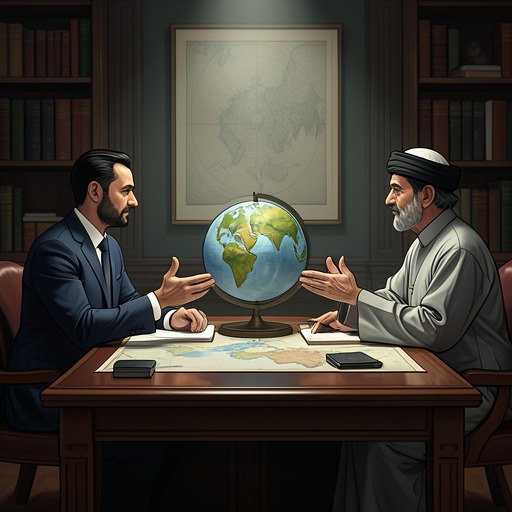
At night, two seaplanes approached an island in the Pacific from opposite directions and settled in a secluded inlet. Each envoy came ashore alone in a rubber coracle. At sunrise the American and Chinese representatives met on the beach and shook hands: one formally, the other with a brotherliness that seemed slightly forced. Their contrasting clothes made the cultural divide visible. The Chinese envoy wore a sky-blue silk pyjama suit embroidered with golden dragons; the American displayed the plain grey coat and breeches associated with the business class’s return to Puritanism. They smoked the Chinese envoy’s cigarettes and set about arranging a new political order.
On the central practical measures they agreed. Both governments were to be overthrown simultaneously, an action the representatives believed possible if finance and the people could be relied upon in both countries. A World Finance Directorate would take their place. It was to include leading commercial and industrial magnates alongside representatives of workers’ organizations, placing economic reorganization in the hands of business and labor rather than the existing national governments. The American was to serve as its first president and the Chinese as its first vice-president.
The proposed settlement also addressed the immediate resource dispute and the unequal development of the regions. Industrial conditions in the East were to be brought into line with those of America, while the American monopoly over Antarctica was to end. The continent’s rich, largely undeveloped resources would instead come under the Directorate’s control. These provisions made the treaty more than a ceasefire: it proposed a new authority over the world’s economy and a redistribution of control over a crucial source of fuel.
Cultural Dispute and Compromise
For a time the conversation proceeded amicably because the practical arrangements seemed settled. The disagreement emerged when the representatives confronted the cultural difference that they had treated as a minor matter. The American objected to the Chinese envoy’s behavior toward the Daughter of Man, and the dispute redirected the negotiations from economic coordination to the question of who had the right to reform whom.
The American made the agreement conditional on a far-reaching program of change in China. He demanded that its people be educated out of what he regarded as lascivious and idle habits and taught a modern scientific religion. Teachers in schools and universities would have to pledge themselves to fundamentalized physics and behaviourism, and to promote worship of Gordelpus, the god of motion. A powerful order of inquisitors, answerable to the Directorate, would oversee the reforms, including a campaign against sexual practices the American considered wasteful of divine energy. In his framing, the conditions were not an incidental addition: without them, he said, he could not stop the war.
The Chinese representative rejected the assumption that American standards should be imposed from outside. He argued that the matter should be settled locally and that neither side could expect the other simply to adopt its values. His resistance did not end the negotiations. The Daughter of Man aligned herself with the American, offering to go with him to work in the dangerous cities of America. Her choice sharpened the dispute into a personal test of allegiance, and the American turned back to the Chinese envoy with the choice between war and cooperation.
The Chinese accepted the terms, but qualified that acceptance. He reasoned that the coordination of activity was the planet’s chief need, and that China’s way of life might withstand opposition rather than be weakened by it. To avoid having the transformation appear as an external imposition, he asked for time to form a native, spontaneous party of Energists that would spread the American gospel in Asia and, in his hope, give it greater elegance. This compromise connected religious propagation to the negotiations’ economic objective: China’s consent would help secure cosmopolitan control of Antarctica.
Signing and Significance
The treaty was signed, and a new, secret codicil was also drawn up and signed. The Daughter of Man witnessed both documents in clear, round, old-fashioned script. The codicil’s contents are not disclosed, so the text establishes that the agreement had a confidential dimension without revealing what additional terms it contained.
For the Daughter of Man, the signing marked a change of allegiance: she regarded her former master as having failed her and chose a new one in the American representative. Her response gives the political pact a personal counterpart, but does not erase its tensions. The American had demanded that Chinese society submit to reform, while the Chinese had secured time to make that program indigenous; apparent agreement rested on sharply different understandings of how cultural change should occur.
The treaty therefore presents world unification as both a practical solution and an unstable promise. It proposed the simultaneous overthrow of two governments, an international directorate joining capital and organized labor, and shared control of Antarctic fuel. Yet its cultural conditions revealed that political and economic unity did not mean equality between the values being unified. The island later became a focal place for cosmopolitan sentiment and a vast Temple of Peace, a symbolic afterlife that echoed the treaty’s ambition while leaving its unresolved conflict over influence and cultural authority in view.